Milestones: A Different Kind of Pressure
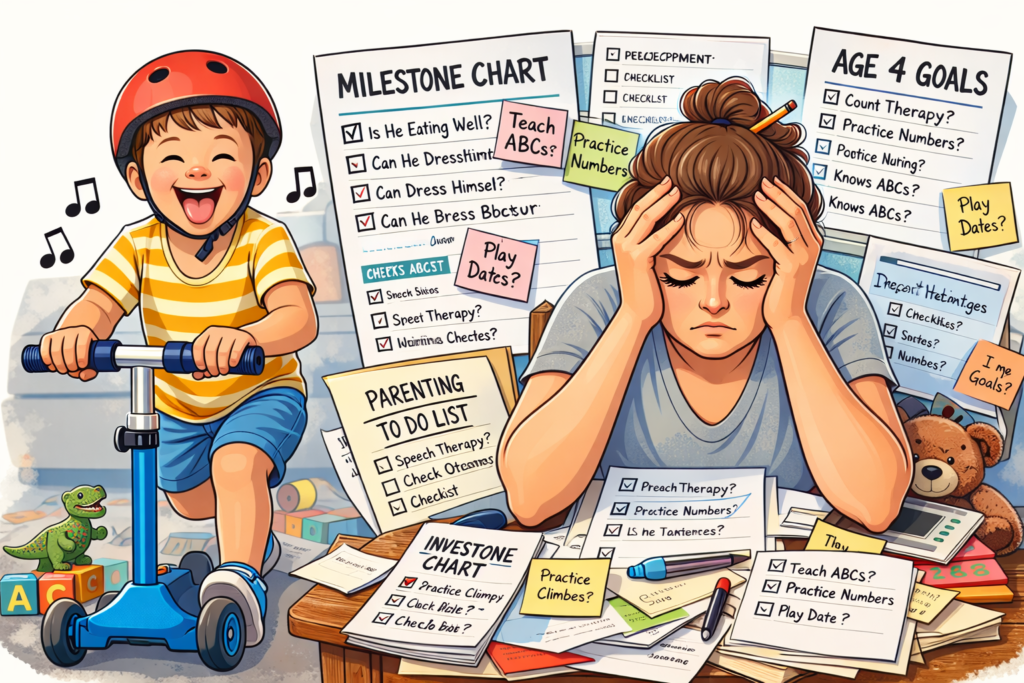
As parents, we hear so much about milestones — the charts, the timelines, the expectations. They come at us from doctors, from schools, from other parents, from the internet. And before we realize it, we’re measuring our children against standards we barely had time to understand.
I’ve been there too. This is my experience, and maybe a little of yours.
Understanding Milestones
I have a son — shy, beautiful, bright, and full of personality. He has hit most of his milestones without any trouble, but language has taken longer. That one delay opened up a new chapter for us, one I didn’t expect.
Every pediatrician visit came with more charts and more questions.
Is he chewing properly? Is he active? Is he dressing himself? At this age, he should be doing this… and this… and this…
It felt like every answer came with another silent judgment.
The Pressure Parents Carry
If you’re a parent, you quickly notice how easy it is to compare.
You see other children writing neatly while yours is still trying.
You hear kids speaking clearly while your child is quieter, still working on words.
And whether you mean to or not, you start wondering if you’re missing something… or if you’re doing enough.
But eventually, I had to stop and ask myself:
Why are we acting like all children come from the same mold?
My son doesn’t.
No child does.
He was born into his story — his timing, his environment, his personality, his everything. Expecting him to move at the same pace as everyone else never made sense.
The Weight of Self-Blame
Still, when he didn’t meet certain milestones, the first place I looked was inward.
Maybe I should have talked more.
Maybe I should have read to him longer.
Maybe he needed more park time.
More practice.
More everything.
You create plans, schedules, goals — anything to “fix” what isn’t broken. You go to bed thinking about tomorrow and wake up thinking about yesterday. It’s exhausting in a way you can’t explain.
Remembering What Truly Matters
Somewhere in all the pressure, I paused long enough to actually look at him — not the milestones, not the charts, not the comparisons. Him.
And I realized:
He is healthy.
He is happy.
He loves to read.
He rides his scooter with confidence.
He sleeps peacefully through the night.
He eats well.
He loves going to school.
He knows his alphabet and the sounds they make.
He knows his numbers.
And he is deeply, completely loved.
He is still learning.
Still growing.
Still figuring things out.
He is becoming who he is meant to be — and nothing is “late” about that.
What This Really Means for Us
Milestones are helpful, but they aren’t the whole story.
They don’t define intelligence or potential.
They don’t determine what kind of parent you are.
And they definitely don’t decide who your child will grow up to be.
Every child deserves time.
Every parent deserves grace.
And every journey deserves to unfold at its own pace.
Conclusion
As parents we need to breathe, give ourselves room, and show ourselves kindness. We are all trying. We are all learning. We are all figuring it out as we go.
Your child is growing exactly as they should.
You are doing more than enough.
And not every milestone needs to happen on someone else’s timeline.
If you ever forget that, come back here. We’ll remember it together.
Theresa James
This captures the inner struggle many parents face when they watch their children struggle with things that seem easy for other children. Parents often wonder if they are not doing enough, if their child is not smart enough, or if something is wrong with the child’s development.
However, accepting that every child is unique and beautifully made for a special purpose helps parents see these challenges differently. It allows them to celebrate every achievement and gently guide, teach, and support their child in reaching new milestones without comparison or judgment. This helps build the child’s confidence and strengthens trust between the child and the parent.
Great article. I love it!
Martha
Thank you!
Z
Thank you for sharing this.
Martha
Thank you!
Patrick
Great piece. Our focus on comparisons makes us to lose sight of our uniqueness as individuals.
Martha
Thank you!
Chris
Outstanding. Thanks for sharing.
Martha
Thank you!
Utaji
This resonates with me. Thanks for sharing.